Many organisations spend millions establishing strategic partnerships.
Engineering Service Partnerships. Preferred Supplier Panels. Joint Ventures. Long-term Operations Contracts. Technology Partnerships. Program Delivery Partnerships.
And yet remarkably little attention is paid to the capability required to make those partnerships successful.
The commercial agreement is negotiated.
The governance structure is established.
The performance measures are defined.
Then the organisations assume the partnership will simply work.
But partnerships do not succeed because two organisations sign an agreement.
They succeed because people from different organisations learn to operate as a coordinated system.
The partnership itself becomes the unit of performance.
This is fundamentally different from team performance.
The mistake organisations make
Most organisational capability models assume performance occurs in one of two places:
- Individual performance
- Team performance
Partnership performance sits in a third category.
A partnership is rarely a real team.
People often:
- Have different employers
- Operate under different incentive systems
- Report through different structures
- Have different cultures
- Have different risk appetites
- Have competing priorities
The challenge is not creating one team.
The challenge is creating enough alignment between two entities that shared value can be created.
That is an entirely different problem.
The Science Behind Partnerships
Research from strategic alliances, inter-organisational collaboration, social capital theory, trust theory and systems thinking repeatedly highlights four ingredients:
The four happen to strongly align with the domains from within the ODAPTIC Partnership Index.

1. Swift Trust
At the beginning of a partnership, there is no history.
No one has earned trust yet.
The only thing available is willingness.
Partnerships that progress quickly establish provisional trust early.
- People choose to assume positive intent.
- They share information earlier.
- They involve each other sooner.
- They solve problems together before they have confidence they can.
ODAPTIC calls this Swift Trust.
Without it, partnerships become contractual rather than collaborative.
2. Earned Trust
Over time assumptions become evidence.
People either:
- do what they say
- demonstrate competence
- support one another under pressure
- make decisions for mutual benefit
Or they don't.
Earned trust is accumulated through hundreds of interactions.
This becomes the relationship bank account.
ODAPTIC identifies Earned Trust as distinct from Swift Trust because mature partnerships require both.
3. Mechanics
Partnerships fail surprisingly often because of systems rather than people.
Examples include:
- unclear decision rights
- duplicate governance
- conflicting KPIs
- poor escalation pathways
- fragmented communication channels
- competing reporting systems
The relationship may be healthy, but the partnership will still fail if the mechanics are broken.
ODAPTIC defines mechanics as the structures, processes and governance that operationalise collaboration.
4. Dynamics
Dynamics are the lived experience of the partnership.
- Do people speak openly?
- Raise concerns?
- Challenge respectfully?
- Solve problems together?
- Share bad news?
- Or do they become political and protective?
ODAPTIC defines dynamics as the human and cultural dimensions that shape daily interaction between partners.
Partnerships Follow Predictable Stages
ODAPTIC’s partners, Jessica and Hannah, have identified that typical Partnerships (regardless of the type or structure) are best treated as developmental journeys rather than static arrangements.
Partnerships typically move through:
Strategic Signalling - "Are we serious about partnering?"
Building Confidence - "Can I trust you?"
Relationship Shaping - "What did we really mean when we agreed to partner?"
Accelerating Integration - "How do we make this work effectively?"
Intentional Performance - "How do we maximise value together?"
Step Change - "What becomes possible because of this partnership?"
Strategic Integration - "We create more value together than apart."
Why this conversation matters
Many partnerships assume everyone shares the same picture of success.
They don't.
Most partnerships fail to explicitly define what successful partnership looks like in practice.
Parties often agree they want to "collaborate", but hold very different assumptions about the level of integration, influence, information sharing and accountability that should exist between them.
At ODAPTIC, we have a Partnership Collaboration Model that provides a practical way to surface and align these expectations before misunderstandings emerge.
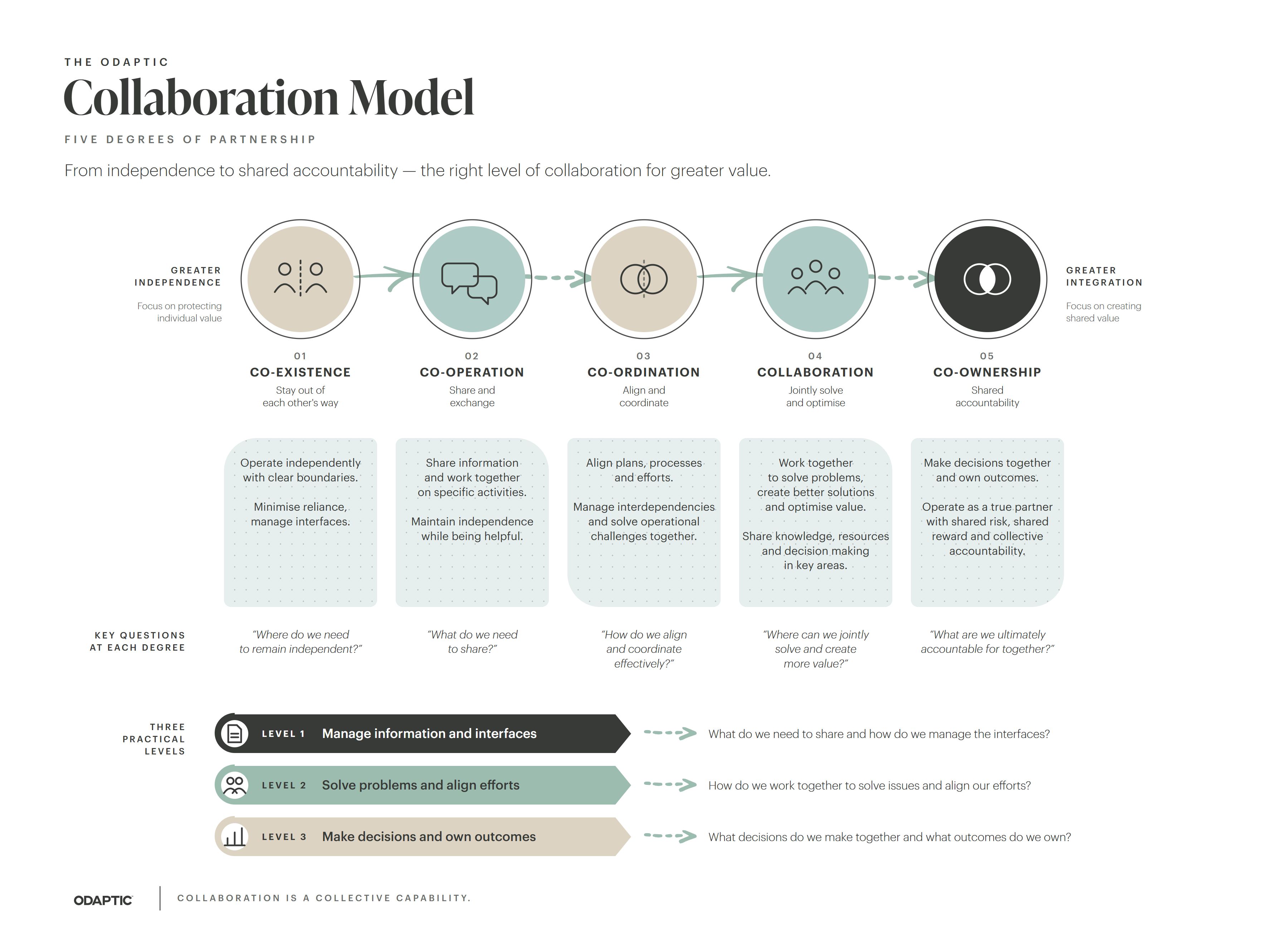
It helps leaders ask:
- Where do we genuinely need integration?
- Where do we need independence?
- What decisions should be shared?
- What decisions should remain with individual entities?
- How much coordination is appropriate for the value we are trying to create?
- What would an external observer see if this partnership was operating at its best?
The outcome is not a generic definition of collaboration.
The outcome is a shared understanding of how this partnership needs to operate to achieve its intended value.
The goal is not maximum collaboration.
The goal is the right level of collaboration to achieve the outcomes the partnership was created to deliver.
More collaboration is not always better collaboration.
Why organisations underinvest in partnerships
The major barriers are rarely budget. They're beliefs.
"The contract will manage it."
A contract can define obligations.
It cannot create collaboration.
"They're professionals. They'll work it out."
Competence does not automatically create integration.
"We don't have time."
Ironically, organisations that are too busy to invest in the partnership usually become consumed by partnership issues later.
"It's a soft issue."
Most partnership breakdowns eventually appear as:
- schedule impacts
- cost impacts
- claims
- governance issues
- turnover
- customer dissatisfaction
The symptoms are commercial.
The cause is relational.
When is the best time to invest?
Most organisations wait until something is broken.
Yet the greatest return comes during four distinct and defining moments for each partnership:
Before selection - Can these organisations realistically work together? What are we hoping to achieve for doing so? What are we prepared to invest to make it work?
During mobilisation - How do we create swift trust? What barriers do we need to remove for each other? Are we prioritising the high value priorities, or the easy ones?
After the first major conflict - Can we turn tension into trust? Are we learning together? Are we adapting together? What shared leadership signals should we send?
During periods of success - How do we avoid complacency? How do we celebrate this success? How do we support each other in the furtherance of broader outcomes?
The Role of the Collaboration Coach for Strategic Partnerships
The Collaboration Coach is not:
- a facilitator
- a team builder
- a consultant
- a project manager
The Collaboration Coach focuses on the health of the partnership system itself.
Similar to how an executive coach observes leadership. A collaboration coach observes the relationship between entities and works between the humans and their supporting systems to ensure that they align towards desired outcomes.
They ask and surface the unspeakable, such as:
- Are the mechanics working?
- Is trust increasing or decreasing?
- Are power dynamics helping or hindering?
- Are expectations really aligned?
- Are the right difficult conversations happening?
- Are leaders behaviours signalling the partnership they claim to want?
- Are we effectively identifying and sifting through points of conflict?
What Does a Collaboration Coach Actually Do?
Creates Awareness - Makes invisible tensions visible.
Activates Conversations - Creates the friction required for alignment.
Strengthens Partnership Capability - Develops the collective capability to partner effectively.
Measures Partnership Health - Using tools such as the Partnership Index.
Accelerates Learning - Helping the partnership move through maturity stages faster.
Protects Long-Term Value - By ensuring the relationship receives the same attention as commercial and technical outcomes.
Partnership Reflection Questions
If you are a Leader of a Strategic Partnership, here are some useful questions you can ask yourself, or take to your next Steering Committee meeting, to reflect on the value that you can gain for investing in the partnership’s health.
Partnership Purpose
- Why does this partnership exist?
- What value becomes possible together that cannot be achieved separately?
- What would make this partnership genuinely strategic rather than transactional?
Trust
- What have we done to actively build swift trust?
- What evidence suggests earned trust is growing?
- Where is trust currently fragile?
Mechanics
- What aspects of our governance create friction?
- Where are responsibilities unclear?
- What decisions take longer than they should?
Dynamics
- What conversations are we avoiding?
- What tensions continue to reappear?
- Are we experiencing partnership or coexistence?
Leadership
- What behaviours are leaders signalling?
- Are leaders reinforcing partnership or organisational self-interest?
- What would our teams observe if they watched us for a week?
Investment
- What would happen if we invested nothing further into this partnership?
- What would become possible if we invested intentionally for the next 12 months?
- What value are we currently leaving on the table?